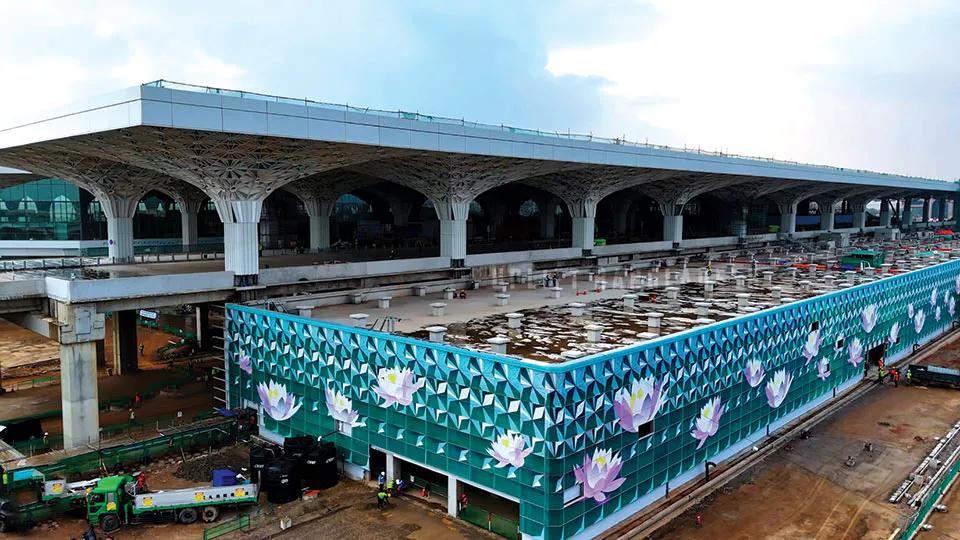
HSIA's T3 at crossroads : Negotiations, global practices, stakes for Bangladesh
Dhaka : After years of construction and an investment of roughly BDT 21,000 crore, the Third Terminal of Hazrat Shahjalal International Airport stands largely ready to transform Bangladesh's aviation sector. Yet despite nearing completion more than a year ago, the country's most ambitious airport infrastructure project remains unopened to commercial operations as negotiations continue over who will operate and maintain the facility. At the center of the debate is a proposed agreement between the Government of Bangladesh and a Japanese consortium expected to manage the terminal under a long-term operations and maintenance arrangement. While both sides have expressed interest in reaching a deal, negotiations have become increasingly complex over questions of revenue sharing, operational control, and risk allocation. Terms under negotiation According to terms discussed in industry circles and reported by local media, the proposed framework would compensate the operator through a combination of revenue-sharing and fixed-volume mechanisms. For passenger services, the consortium would reportedly receive either 22.5 percent to 27 percent of terminal revenues or a fixed payment of approximately USD 2.1 per passenger. For cargo operations, the proposal includes either a similar revenue-sharing formula or a payment of around USD 11.5 per ton of cargo handled. The reported proposal also suggests that the revenue-sharing component would begin at 22.5 percent during the initial years of operation, with higher rates linked to future performance thresholds. Why stakeholders are concerned Another aspect attracting attention is the reported risk-sharing mechanism. According to industry sources familiar with the discussions, if revenues exceed projections by more than 10 percent, the majority of additional earnings would accrue to the Civil Aviation Authority of Bangladesh (CAAB). However, if revenues fall significantly below projections, Bangladesh could be required to absorb a substantial portion of the shortfall. The Japanese side has reportedly described the arrangement as a balanced structure designed to align incentives and provide operational certainty. However, some policymakers, economists, and aviation specialists in Bangladesh have questioned whether the proposed allocation of revenues and risks adequately reflects the country's long-term interests. Global airport concessions : What is norm? The debate has increasingly shifted beyond the specifics of the negotiations and toward a broader question: how do similar airport management arrangements work elsewhere in the world? Internationally, airport management contracts typically fall into several categories, ranging from simple management agreements to full concession and public-private partnership (PPP) models. In many cases, operators assume significant commercial and traffic risks in exchange for a share of airport revenues and long concession periods. For example, major international operators such as Fraport, Changi Airports International, Aéroports de Paris, and TAV Airports have participated in airport concessions across Asia, Europe, the Middle East, and Latin America. These agreements often incorporate performance benchmarks, service-level obligations and revenue-sharing formulas tied to passenger growth and commercial performance. Lessons from int'l airport partnerships Industry analysts noted that many successful airport PPPs rely on phased or performance-linked revenue structures rather than fixed arrangements from the outset. In some cases, operators receive management fees combined with performance incentives tied to passenger satisfaction, operational efficiency and traffic growth. In others, governments secure minimum guaranteed payments while allowing operators to retain upside potential if they successfully expand airport activity. Risk sharing: Int'l practice vs proposed structure Another common feature of international airport concessions is the allocation of commercial risk. In numerous PPP models, operators bear a significant portion of demand and traffic risks because they are expected to improve efficiency, attract airlines and expand commercial revenues. This approach is intended to align financial rewards with operational performance. Can higher revenues justify greater operator compensation? The Dhaka negotiations have drawn particular scrutiny because the Third Terminal itself has already been constructed through public investment supported by financing from the Japan International Cooperation Agency (JICA). As a result, some observers argued that the government should seek stronger financial returns from an asset that is already largely built, while others contend that world-class airport operations require specialized expertise that can justify substantial operator compensation. Supporters of international management point to the potential benefits of professional airport operations, including reduced passenger processing times, improved baggage handling, better commercial development and stronger integration into global aviation networks. They argue that a high-performing operator could ultimately increase overall airport revenues, generating greater long-term benefits for Bangladesh even if a portion of those revenues is shared. Critics, however, caution that contract design will be critical. They argue that any agreement should include clearly defined service-level agreements, measurable performance indicators, transparent reporting requirements and balanced risk-sharing provisions. Without such safeguards, they warn, Bangladesh could face reduced revenue potential or unexpected fiscal obligations over the life of the concession. Policy choices facing Bangladesh For Bangladesh, the stakes extend far beyond a single airport contract. The Third Terminal is expected to serve as the country's primary international aviation gateway for decades to come and as a key piece of infrastructure supporting trade, tourism, and investment. As negotiations continue, policymakers face a delicate balancing act: securing global expertise capable of operating a modern international hub while ensuring that the economic benefits of the country's largest aviation investment remain aligned with national interests. The outcome of the talks will likely shape not only the future of Dhaka's airport but also the framework for how Bangladesh approaches major infrastructure partnerships in the years ahead.